Farley was originally cast as the voice of the title character in the movie Shrek,
recording about 80–90% of the character's dialogue, but died just
before recording was finished. A story reel featuring a sample of
Farley's recorded dialogue was released officially in 2015.[31] The original version of Shrek was more like Farley himself, according to his brother.[32]
Farley was slated for another voice role in Dinosaur
as a young male brachiosaurus named Sorbus who, despite his gigantic
nature, was frightened of heights. After his death, the character was
rewritten as Baylene, an elderly female Brachiosaurus played by British
actress Joan Plowright.[33]
At the time of his death, Farley had been in talks to costar with Vince Vaughn in The Gelfin, and to star in a biographical film about comedian Fatty Arbuckle.[34][35] Jim Carrey's role in the 1996 film The Cable Guy was originally intended for Farley, but scheduling conflicts forced him to decline.[36]
Farley was slated to appear in a third Ghostbusters film, which was at the time intended to be about a new trio of Ghostbusters taking on overpopulation in Hell.[36][37] Dav Pilkey, author of the children's book series Captain Underpants,
had wanted Farley to play the title role in a potential television
series based on the books, but discarded the idea after Farley's death.[38]
Farley had been in talks for the lead in an adaptation of the novel A Confederacy of Dunces.[39] Farley even expressed interest in portraying Atuk in an adaptation of the novel The Incomparable Atuk.[40] Both of these shelved projects, along with the Arbuckle biopic, have been alleged to be cursed as Farley, John Belushi, and John Candy were each attached to all three roles, and all three died before any of the films entered production.[36][41]
Friday, April 7, 2017

Career
Saturday Night Live
Along with Chris Rock, Farley was one of two new Saturday Night Live cast members announced in the spring of 1990.[2][3] On SNL, Farley frequently collaborated with his fellow cast members Adam Sandler, Chris Rock, Rob Schneider, and David Spade, among others. This group came to be known as the "Bad Boys of SNL."[12]Popular characters performed by Farley included Matt Foley, an over-the-top motivational speaker who constantly reminded other characters that he "lived in a van, down by the river". The name of the character was drawn from a real life friend of Farley's named Matt Foley, who, during a troubled period, lived in a van near a river. He later became a Catholic priest and appeared in the 2015 documentary "I am Chris Farley". In early renditions of the character, Farley used other names, depending on whom he knew in the audience, until the real life Foley went to the show and had his name used, at which point Farley felt the name best suited the character and refused to change it. Some of the mannerisms of the character were a combination of the positions Farley noticed his Rugby teammates take (at the pitch), coupled with the angry, high pitched yet low volume/muffled voice his father used when he was angry;[13] Todd O'Connor of Bill Swerski's Superfans, a group of stereotypical Chicagoans who constantly shouted "da Bears!";[14] a Chippendale's dancer, in a famous sketch that paired him with guest host Patrick Swayze;[15] one of the "Gap Girls", who hung out together at a local mall; a stereotypical lunch lady, to the theme of Lunchlady Land performed by Adam Sandler;[16] Bennett Brauer, a Weekend Update commentator who often divulged his personal and hygienic problems via air quotes; and himself on The Chris Farley Show, a talk show in which Farley quite often "interviewed" the guest, regularly getting very nervous.
Some of these characters were brought to SNL from his days at Second City. Farley also performed impersonations of Tom Arnold, who gave Farley's eulogy at his private funeral; Andrew Giuliani, Jerry Garcia, Meat Loaf, Norman Schwarzkopf, Dom DeLuise, Roger Ebert, Carnie Wilson, Newt Gingrich, Mindy Cohn, Mama Cass, Hank Williams, Jr., and Rush Limbaugh.[17]
Off-screen, Farley was well known for his pranks in the offices of Saturday Night Live. This would refer to Sandler and Farley making late-night prank phone calls from the SNL offices in Rockefeller Center, with Sandler speaking in an old woman's voice and Farley farting into the phone and mooning cars from a limousine. He was also known to frequently get naked and do various stunts for laughs. Chris Rock once claimed that he probably saw Farley's private parts more than Farley's girlfriend did.[18][19][20] Sandler told Conan O'Brien on Late Night that NBC fired him and Farley from the show in 1995.[21]
Film career
During his time on SNL, Farley appeared in the comedy films Wayne's World,[22] Coneheads,[23] Airheads,[24] and uncredited in Billy Madison.[25] He also appeared in the Red Hot Chili Peppers music video for "Soul to Squeeze", which was a song featured on the Coneheads soundtrack.[26]After Farley and most of his fellow cast members were released from their contracts at Saturday Night Live following the 1994–1995 season, Farley began focusing on his film career. His first two major films co-starred his fellow SNL colleague and close friend David Spade. Together, the duo made the films Tommy Boy and Black Sheep. These were a success at the domestic box office, earning around $32 million each and gaining a large cult following on home video.[27][28]
The two films established Farley as a relatively bankable star and he was given the title role of Beverly Hills Ninja, which finished in first place at the box office on its opening weekend.[29]
Drug and alcohol abuse-related problems interfered with Farley's film work at this time. Production of his final film, Almost Heroes, was held up several times so Farley could enter rehab. He was known among comedic contemporaries and friends to be sensitive about how his comedy was perceived ("fatty-fall-down"), and was particularly hurt by harsh critical reactions to Tommy Boy, a film he enjoyed making. He was particularly dissatisfied with Black Sheep, an attempt by the studio to recapture the chemistry on Tommy Boy and was only 60 pages into the script when the project was green-lit. As a result, he relapsed again the night of the premier, which required further rehab before he would begin to work on Beverly Hills Ninja.[30] After his death on December 18, 1997, his final completed films, Almost Heroes and Dirty Work, were released posthumously.
Chris Farley
From Wikipedia, the free encyclopedia
| Chris Farley | |
|---|---|

Promotional photo of Farley for
Saturday Night Live in the 1990s |
|
| Born | Christopher Crosby Farley February 15, 1964 Madison, Wisconsin, U.S. |
| Died | December 18, 1997 (aged 33) Chicago, Illinois, U.S. |
| Cause of death | Cocaine intoxication, morphine overdose and atherosclerosis |
| Resting place | Resurrection Catholic Cemetery, Madison, Wisconsin |
| Alma mater | Marquette University |
| Occupation | Actor, comedian |
| Years active | 1981–1997 |
| Parent(s) | Tom Farley, Sr. Mary Anne Farley |
| Relatives | Tom Farley (brother) John P. Farley (brother) Kevin Farley (brother) Barbara Farley (sister) Jim Farley (cousin) |
Contents
Early life
Farley was born on February 15, 1964 in Madison, Wisconsin. His father, Thomas John Farley, Sr. (1936–1999), owned an oil company, and his mother, Mary Anne (née Crosby), was a housewife.[2][4][5] He had four siblings: Tom Jr., Kevin, John, and Barbara. His cousin, Jim, is the CEO and Chairman at Ford Motor Company Europe.[6][7]Farley's family is Roman Catholic and of Irish and Scottish descent, and Farley attended numerous Catholic schools in his hometown, including Edgewood High School of the Sacred Heart. According to Joel Murray, a fellow Second City cast member, Farley would "always make it to Mass."[8] Many of his summers were spent as a camper and counselor at Red Arrow Camp, near Minocqua, Wisconsin. He graduated from Marquette University in 1986, with a concentration in communications and theater.[9] At Marquette, he played rugby and discovered a love for comedy.[10] After college, he worked with his father at the Scotch Oil Company in Madison.[11] He got his start in professional comedy at the Ark Improv Theatre in Madison, and at the Improv Olympic theater in Chicago. He then performed at Chicago's Second City Theatre, initially as part of Second City's touring group. He was eventually promoted to their main stage.[citation needed]
Tenants and businesses
- Mayle, Ray & Mayle LLC
- Accent Chicago
- Best Buy[36]
- The Cheesecake Factory[37]
- Cimaglia Productions
- Consulate-General of Chile in Chicago, Suite 3352[38]
- Consulate General of Denmark, Chicago, Suite 3950[39]
- Elephants, Etc.
- Big Shoulders Digital Video Production[40]
- Exclusively Gourmet, Ltd.
- Etihad Airways (31st Floor)[41]
- Fingers & Toes Nail Salon
- Gateway Newsstand & Snack Shop
- Golin (PR firm), Suite 2600 [42]
- Hanig's Footwear[43]
- 360° Chicago
- Laurichem Inc., Suite 8609
- The North Face[37]
- The Signature Room at the 95th[44]
- Regus, Suite 3100
- Qatar Airways, Suite 1310[45]
- Weber Shandwick, Suite 2400 [46]
- WDRV 97.1, Classic Rock Radio Station, Suite 1510[47]
- FCB (advertising agency) [48][49]
- Starbucks, Suite 3
-
 A view of the Hancock Center at sunset
-
 Side view of the Hancock Center
-
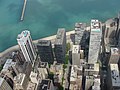 A view of Lake Michigan from the observatory in the Hancock Center
-
 A detailed view of the two antenna spires atop the John Hancock Center
-
 A view of the Hancock Center as seen from
This is a dynamic list and may never be able to satisfy particular standards for completeness. You can help by expanding it with reliably sourced entries.
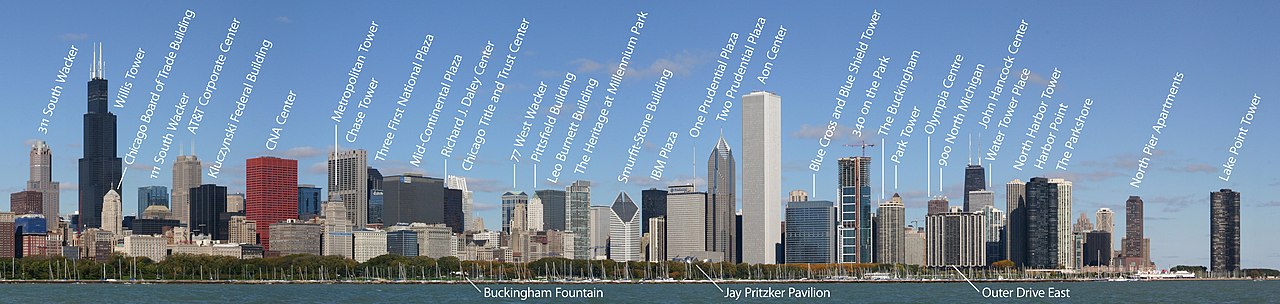
Panorama of the skyline of Chicago
Gallery


Height
Including two antennas, the John Hancock Center has a height of 1,499
feet (457 m), making it the thirty-third tallest building in the world
when measured to pinnacle height. The Observatory elevators of the John
Hancock center, manufactured by Otis, travel 96 floors at a top speed of 1,800 ft/min (20 mph; 9.1 m/s).
360° Chicago
Located on the 94th floor, 360° Chicago is the John Hancock Center's observatory. The floor of the observatory is 1,030 feet (310 m) off of street-level below. The entrance can be found on the concourse level of the John Hancock Center; mainly accessible by the Michigan Avenue side of the building. The observatory, previously called the John Hancock Observatory, has been independently owned and operated since 2014 by the Montparnasse 56 Group out of Paris, France.[32] The elevators are credited to be the fastest in the Western Hemisphere, at a top speed of 1,800 ft/min (20.5 mph).[33] The observatory boasts larger floor space than its direct competitor, Skydeck at the Willis Tower. In addition, 360° Chicago has a cafe by Lavazza Coffee which stocks alcoholic beverages as well.[34] In the summer of 2014, 360° Chicago added its TILT attraction. The TILT platform is an additional fee, and is a series of floor to ceiling windows that slowly tilt outside the building to 30°.[35] The platform is on the observatory level, and faces south over the city. This observatory sees less attendance than the Skydeck at the Willis Tower, leading to a quieter and quicker experience.Design
One of the most famous buildings of the structural expressionist style, the skyscraper's distinctive X-braced
exterior shows that the structure's skin is part of its 'tubular
system'. This is one of the engineering techniques which the designers
used to achieve a record height (the tubular system
is the structure that keeps the building upright during wind and
earthquake loads). This X-bracing allows for both higher performance
from tall structures and the ability to open up the inside floorplan.
Such original features have made the John Hancock Center an
architectural icon. It was pioneered by Bangladeshi-American structural
civil engineer Fazlur Khan and chief architect Bruce Graham.
The interior was remodeled in 1995, adding to the lobby travertine, black granite, and textured limestone surfaces. The elliptical-shaped plaza outside the building serves as a public oasis with seasonal plantings and a 12-foot (3.7 m) waterfall. A band of white lights at the top of the building is visible all over Chicago at night, and changes colors for different events. For example, at Christmas time the colors are green and red. When a Chicago-area sports team goes far in the playoffs, the colors are changed to match the team's colors.
The building is a member of the World Federation of Great Towers. It has won various awards for its distinctive style, including the Distinguished Architects Twenty-five Year Award from the American Institute of Architects in May 1999.[29]
The building is only partially protected by a fire sprinkler system,[30] as the residential floors do not have sprinklers.[31]
The interior was remodeled in 1995, adding to the lobby travertine, black granite, and textured limestone surfaces. The elliptical-shaped plaza outside the building serves as a public oasis with seasonal plantings and a 12-foot (3.7 m) waterfall. A band of white lights at the top of the building is visible all over Chicago at night, and changes colors for different events. For example, at Christmas time the colors are green and red. When a Chicago-area sports team goes far in the playoffs, the colors are changed to match the team's colors.
The building is a member of the World Federation of Great Towers. It has won various awards for its distinctive style, including the Distinguished Architects Twenty-five Year Award from the American Institute of Architects in May 1999.[29]
The building is only partially protected by a fire sprinkler system,[30] as the residential floors do not have sprinklers.[31]
History
The project, which would at that time become the world's second tallest building, was originally conceived of and owned by Jerry Wolman
in late 1964, the project being financed by John Hancock Mutual Life
Insurance Co. Construction of the tower was interrupted in 1967 due to a
flaw in an innovative engineering method used to pour concrete in
stages that was discovered when the building was 20 stories high.[15] The engineers were getting the same soil settlements for the 20 stories that had been built as what they had expected for the entire
99 stories. This forced the owner to stop development until the
engineering problem could be resolved, and resulted in a credit crunch.
This situation is similar to the one faced during the construction of
111 West Wacker, then known as the Waterview Tower.
Wolman's bankruptcy resulted in John Hancock taking over the project,
which retained the original design, architect, engineer, and main
contractor.
The building's first resident was Ray Heckla, the original building engineer, responsible for the residential floors from 44 to 92. Heckla moved his family in April 1969, before the building was completed.
On November 11, 1981, Veterans Day, high-rise firefighting and rescue advocate Dan Goodwin, for the purpose of calling attention to the inability to rescue people trapped in the upper floors of skyscrapers, successfully climbed the building's exterior wall. Wearing a wetsuit and using a climbing device that enabled him to ascend the I-beams on the building's side, Goodwin battled repeated attempts by the Chicago Fire Department to knock him off. Fire Commissioner William Blair ordered Chicago firemen to stop Goodwin by directing a fully engaged fire hose at him and by blasting fire axes through nearby glass from the inside. Fearing for Goodwin's life, Mayor Jane Byrne intervened and allowed him to continue to the top.[16][17]
The John Hancock Center was featured in the 1988 movie Poltergeist III.
On December 18, 1997, comedian Chris Farley was found dead in his apartment on the 60th floor of the John Hancock Center.[18][19]
On March 9, 2002, part of a scaffold fell 43 stories after being torn loose by wind gusts around 60 mph (100 km/h) crushing several cars, killing three people in two of them. The remaining part of the stage swung back-and-forth in the gusts repeatedly slamming against the building, damaging cladding panels, breaking windows, and sending pieces onto the street below.
On December 10, 2006, the non-residential portion of the building was sold by San Francisco based Shorenstein Properties LLC for $385 million and was purchased by a joint venture of Chicago-based Golub & Company and the Whitehall Street Real Estate Funds.[20] Shorenstein had bought the building in 1998 for $220 million.
Golub defaulted on its debt and the building was acquired in 2012 by Deutsche Bank AG who subsequently carved up the building.[21] The venture of Deutsche Bank AG and New York-based NorthStar Realty Finance Corp. paid an estimated $325 million for debt on the Hancock in 2012 after its previous owners defaulted on $400 million in loans.[22] The observation deck was sold to Paris-based Montparnasse 56 Group for $35 million and $45 in July 2012.[23] That same month, Prudential Real Estate Investors acquired the retail and restaurant space for almost $142 million.[24] In November 2012, Boston-based American Tower Corp affiliate paid $70 million for the antennas.[25] In June 2013, a venture of Chicago-based real estate investment firm Hearn Co., New York-based investment firm Mount Kellett Capital Management L.P. and San Antonio-based developer Lynd Co. closed on the expected acquisition of the Hancock's 856,000 square feet of office space and 710-car parking deck. The Chicago firm did not disclose a price, but sources said it was about $145 million.[22] This was the last step in that piecemeal sale process.[22] In May 2016, Hearn Co. announced that they were seeking buyers for the naming rights with possible signage rights for the building.[26]
An annual stair climb race up the 94 floors from the Michigan Avenue level to the observation deck called 'Hustle up the Hancock' is held on the last Sunday of February. The climb benefits the Respiratory Health Association of Metropolitan Chicago. The record time as of 2007 is 9 minutes 30 seconds.
On April 16, 2009 at 6:00AM CDT, WYCC-TV transmitting off the John Hancock switched to all-digital broadcasting, becoming Chicago's first television station to stop broadcasting in an analog signal.[27] WYCC-TV is one of only two Chicago market full-power television stations which broadcast from the top of the John Hancock Center. The other is WGBO-DT, while all of the other area stations broadcast from the top of the Willis Tower.
On November 21, 2015, a fire broke out in an apartment on the 50th floor of the building. The Chicago Fire Department was able to extinguish the fire after an hour and a half; five people suffered minor injuries.[28]
In 2017, Lego Architecture did a Chicago Skyline with John Hancock Center featured as one of the buildings of Chicago. The other Chicago buildings are the Willis Tower, CNA Plaza, Wrigley Building.
The building's first resident was Ray Heckla, the original building engineer, responsible for the residential floors from 44 to 92. Heckla moved his family in April 1969, before the building was completed.
On November 11, 1981, Veterans Day, high-rise firefighting and rescue advocate Dan Goodwin, for the purpose of calling attention to the inability to rescue people trapped in the upper floors of skyscrapers, successfully climbed the building's exterior wall. Wearing a wetsuit and using a climbing device that enabled him to ascend the I-beams on the building's side, Goodwin battled repeated attempts by the Chicago Fire Department to knock him off. Fire Commissioner William Blair ordered Chicago firemen to stop Goodwin by directing a fully engaged fire hose at him and by blasting fire axes through nearby glass from the inside. Fearing for Goodwin's life, Mayor Jane Byrne intervened and allowed him to continue to the top.[16][17]
The John Hancock Center was featured in the 1988 movie Poltergeist III.
On December 18, 1997, comedian Chris Farley was found dead in his apartment on the 60th floor of the John Hancock Center.[18][19]
On March 9, 2002, part of a scaffold fell 43 stories after being torn loose by wind gusts around 60 mph (100 km/h) crushing several cars, killing three people in two of them. The remaining part of the stage swung back-and-forth in the gusts repeatedly slamming against the building, damaging cladding panels, breaking windows, and sending pieces onto the street below.
On December 10, 2006, the non-residential portion of the building was sold by San Francisco based Shorenstein Properties LLC for $385 million and was purchased by a joint venture of Chicago-based Golub & Company and the Whitehall Street Real Estate Funds.[20] Shorenstein had bought the building in 1998 for $220 million.
Golub defaulted on its debt and the building was acquired in 2012 by Deutsche Bank AG who subsequently carved up the building.[21] The venture of Deutsche Bank AG and New York-based NorthStar Realty Finance Corp. paid an estimated $325 million for debt on the Hancock in 2012 after its previous owners defaulted on $400 million in loans.[22] The observation deck was sold to Paris-based Montparnasse 56 Group for $35 million and $45 in July 2012.[23] That same month, Prudential Real Estate Investors acquired the retail and restaurant space for almost $142 million.[24] In November 2012, Boston-based American Tower Corp affiliate paid $70 million for the antennas.[25] In June 2013, a venture of Chicago-based real estate investment firm Hearn Co., New York-based investment firm Mount Kellett Capital Management L.P. and San Antonio-based developer Lynd Co. closed on the expected acquisition of the Hancock's 856,000 square feet of office space and 710-car parking deck. The Chicago firm did not disclose a price, but sources said it was about $145 million.[22] This was the last step in that piecemeal sale process.[22] In May 2016, Hearn Co. announced that they were seeking buyers for the naming rights with possible signage rights for the building.[26]
An annual stair climb race up the 94 floors from the Michigan Avenue level to the observation deck called 'Hustle up the Hancock' is held on the last Sunday of February. The climb benefits the Respiratory Health Association of Metropolitan Chicago. The record time as of 2007 is 9 minutes 30 seconds.
On April 16, 2009 at 6:00AM CDT, WYCC-TV transmitting off the John Hancock switched to all-digital broadcasting, becoming Chicago's first television station to stop broadcasting in an analog signal.[27] WYCC-TV is one of only two Chicago market full-power television stations which broadcast from the top of the John Hancock Center. The other is WGBO-DT, while all of the other area stations broadcast from the top of the Willis Tower.
On November 21, 2015, a fire broke out in an apartment on the 50th floor of the building. The Chicago Fire Department was able to extinguish the fire after an hour and a half; five people suffered minor injuries.[28]
In 2017, Lego Architecture did a Chicago Skyline with John Hancock Center featured as one of the buildings of Chicago. The other Chicago buildings are the Willis Tower, CNA Plaza, Wrigley Building.
Subscribe to:
Posts (Atom)